


- 11 Aug, 2025
- 0 Comments
- 9 Mins Read

How to write humor based UGC ad scripts for direct response ads? (Step-by-step Guide)
Another study from Oracle found that 90% of people were more likely to remember a brand’s ad more if it was funny, while 48% said they didn’t feel they had a relationship with a brand unless it made them smile or laugh. As the old advertising adage goes, “If you can make someone laugh, you can sell them.”
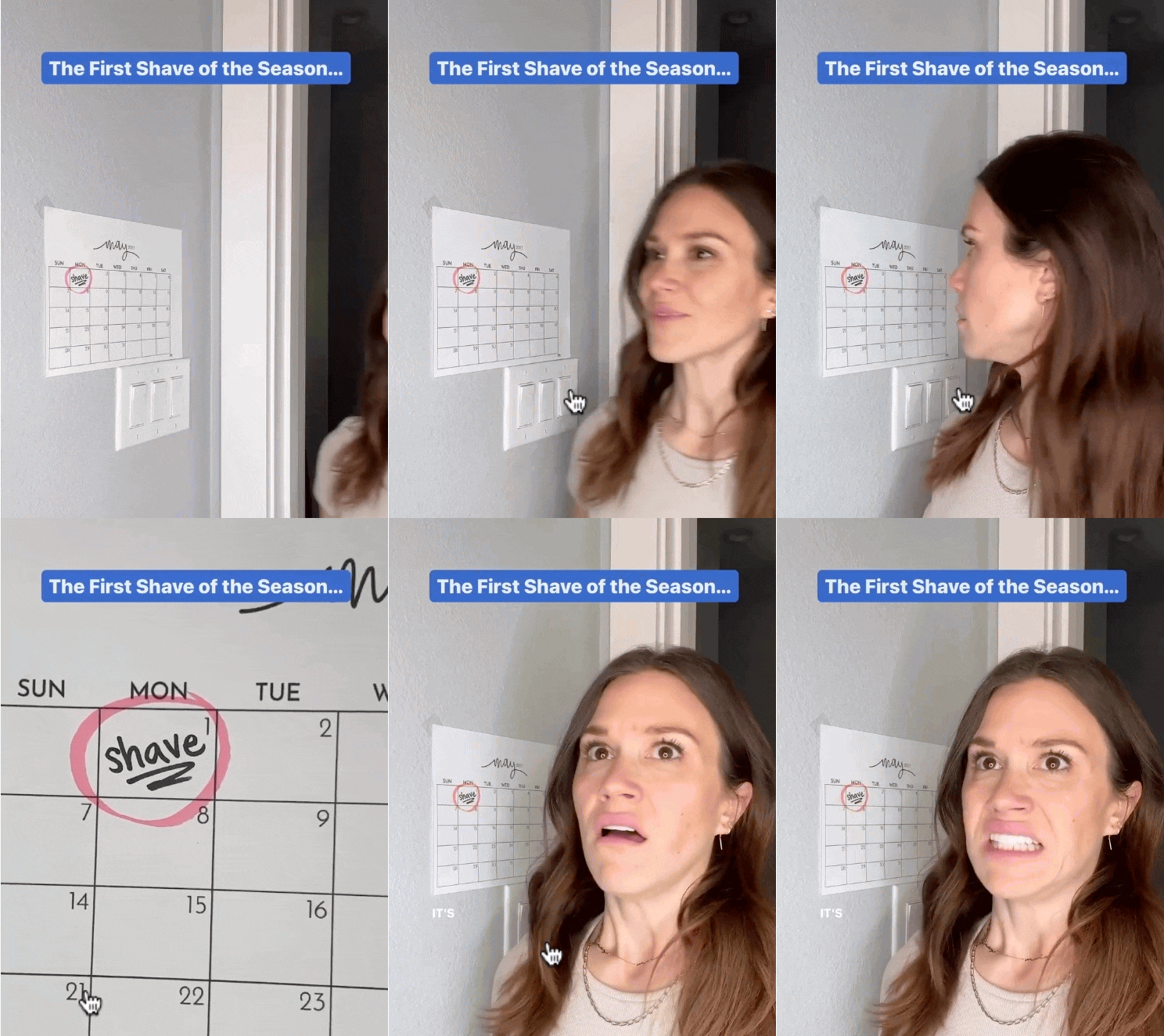
Creating funny and entertaining UGC (User-Generated Content) ad scripts that incorporate elements of persuasion can make your content more engaging and memorable. Here’s a step-by-step guide to help you craft such scripts:
Step 1: Diagnose the Pain
- Identify the Common Pain Points: Start by researching and listing common problems your audience faces that your product can solve. Humor often begins with a pain point that many can relate to.
- Choose Relatable Scenarios: Select exaggerated yet relatable scenarios to emphasize these pain points in a humorous way.
- Craft a Relatable Character: Develop a character personifying your target audience’s struggles. This character will later find a solution in your product.
| Pain Points | Relatable Scenarios | Relatable Characters |
|---|---|---|
| 1. Confusion on where to start | Trying and failing at every machine | Joe, the gym newbie |
| 2. Lack of motivation | Staring at the treadmill before walking away | Tina, the uninspired |
| 3. Boredom with routine | Doing the same old exercises, looking bored | Rick, the routine robot |
| 4. Intimidation from gym-goers | Hiding from gym buffs in the locker room | Sam, the shy one |
| 5. No measurable progress | Checking the scale and sighing | Liz, the plateaued patron |
| 6. Scheduling and time management | Rushing through workouts, constantly checking watch | Alex, the busy bee |
Step 2: Prepare Your Claims
- List Product Features: Write down all the features of your product that address the pain points identified.
- Turn Features into Benefits: Translate these features into benefits that will resonate with the audience’s primal brain, which responds to tangible rewards.
- Test and Refine Claims: Use humor to make your claims memorable. Test different versions to see what resonates best with your audience.
| Product Features | Features Turned into Benefits | Claims to Test and Refine |
|---|---|---|
| 1. Personalized workout plans | Plans tailored to your goals mean no more gym confusion | “Say goodbye to guesswork with our custom workout wizard!” |
| 2. Trackable progress | Visible gains keep motivation soaring | “Watch your progress soar from ‘meh’ to ‘wow’ with each session!” |
| 3. Variety of exercises | Never get bored with countless workout options | “Boredom busters at your fingertips—new workout, every day!” |
| 4. Scheduling flexibility | Work out on your own time, any time | “Your workout, your schedule—anytime, anywhere fitness!” |
| 5. Social Community | Connect with fellow gym-goers without the intimidation | “Join our tribe of fitness buddies—no gym-timidation here!” |
| 6. Guided workout animations | Easy-to-follow guides for every exercise | “Follow the fun with our animated trainers—perfect form every time!” |
Step 3: Demonstrate the Gain
- Show the Transformation: Using an upbeat and amusing tone, use before and after scenarios to depict the transformation your product offers.
- Quantify the Benefits: If possible, use numbers or comparisons to highlight the gain humorously (e.g., “Our app makes budgeting 90% less scary than a horror movie!”).
- Create a Rewarding Ending: Ensure that the end of your script provides emotional satisfaction, leaving the audience with a positive association with your brand.
| Transformation Aspect | How to Showcase Benefit | Emotional Ending to Script |
|---|---|---|
| 1. From confusion to mastery | Before/after Joe’s understanding of workouts | Joe leading a workout group, beaming with pride |
| 2. From low to high motivation | Tina’s growing enthusiasm and energy levels | Tina excitedly planned her next workout |
| 3. From boredom to excitement | Rick’s delighted reactions to new workout routines | Rick enthusiastically shares his workout with his friends |
| 4. From shy to confident | Sam starts in the back row, ending up leading the class | Sam smiling, helping another shy gym-goer |
| 5. From plateau to progress | Liz’s progress chart shows constant improvements | Liz is showing off her new personal best |
| 6. From rushed to relaxed | Alex’s transition from hurried to well-paced workouts | Alex is enjoying a post-workout smoothie peacefully |
Step 4: Deliver to the Primal Brain
- Keep It Simple: Your script should be easy to understand, even with a glance or listen, catering to the primal brain’s preference for simplicity.
- Invoke Strong Emotions: Use humor to evoke happiness and surprise, engaging the emotional brain.
- Ensure It’s Visually Engaging: Include descriptions for visual gags or expressions that can make your ad visually funny and entertaining.
| Keep It Simple | Invoke Emotions | Visually Engaging Element |
|---|---|---|
| “Get fit. Not confused.” | Show characters celebrating their successes | Close-ups of the app’s simple interface |
| “Stay motivated. Stay happy.” | Characters laughing and high-fiving after workouts | Vibrant graphics displaying workout achievements |
| “Excitement in every exercise.” | Characters’ surprised and joyful expressions | Dynamic transitions between different exercises |
| “Fit in. Stand out.” | Shots of characters feeling accepted and proud | Engaging social features of the app highlighted |
| “Every rep counts. Every pound lost.” | Progress graphs shooting upwards like fireworks | Before/after visuals of characters’ transformations |
| “Your time. Your workout.” | Characters relaxed and worked out at their own pace | Timelapse of a full workout in different settings |
Step 5: Callback
Objective: Reinforce humor and memorability by tying the end of the script back to the original setup or hook.
-
Comedy Principle: Callbacks bring the audience full circle, making the payoff feel stronger and more satisfying.
-
Advertising Principle: Repetition of the joke + product benefit boosts recall and strengthens brand association.
-
Persuasion Principle: It provides emotional closure before the CTA, so the viewer feels the “story arc” is complete.
Step 6: Master Timing and Pacing
Objective: Optimize humor’s impact through careful editing.
- Perfect the Pause: Allow brief pauses after punchlines for audience reaction.
- Maintain Pacing: Keep the content rhythmic and brisk to avoid boredom and confusion.
- Edit for Impact: Ensure sharp editing to emphasize humor and streamline narrative flow.
- Sync Visuals with Audio: Align audio cues with visual gags for maximum comedic effect.
Final Script Outputs
| Callback Type | How to Use | Example |
|---|---|---|
| Flip the Setup | Reverse the initial pain point with confidence or humor | Joe starts clueless with the treadmill → ends commanding it |
| Exaggerated Repeat | Repeat the first gag but make it bigger or funnier | Tina yawns at start → yawns again mid-dance because she’s too energetic now |
| Role Reversal | Character switches places from weakness to strength | Sam hides behind the plant → ends leading others out from hiding |
| Running Gag | Use the same funny prop/line in a new context | Resistance band traps Joe at start → later he’s using it perfectly |
| Subtle Nod | Quick wink or side comment to audience referencing the opener | “Guess I’m not invisible anymore.” |
Script 1: Joe’s Gym Jamboree
| Scene | Action | Dialogue / Voiceover | Notes |
|---|---|---|---|
| 1 – Cold Open | Joe pokes treadmill, confused | Joe: “Is this thing voice-activated? Treadmill, start workout!” | Setup of gag |
| 2 – Pain Point | Joe tangled in resistance bands | VO: “His workouts? Well, they’re a stretch… the wrong kind.” Joe (muffled): “Little help here?” |
Exaggerated struggle |
| 3 – Solution Intro | Joe opens FitFrenzy app | VO: “Enter FitFrenzy. The app that turned Joe’s workout woes into wins!” | Product enters as hero |
| 4 – Transformation | Joe lifts confidently | Joe: “Now I’m the one telling machines what to do!” | Contrast before vs after |
| 5 – CTA + Callback | Joe flexes → then smirks at treadmill | Joe: “Join me and become a gym wizard with FitFrenzy! Download now!” 🔄 Callback: “Hey treadmill… start workout. Oh wait—I’M the boss now!” |
Loop closure |
Script 2: Tina’s Transformation
| Scene | Action | Dialogue / Voiceover | Notes |
|---|---|---|---|
| 1 – Cold Open | Tina snoozes on yoga mat | VO: “Tina used to play dead during workout time. Motivation? Zero.” | Lazy setup |
| 2 – Pain Point | Tina on treadmill (switched off) | VO: “Her treadmill’s been collecting more dust than miles.” Tina (yawning): “Is it nap time yet?” |
Relatable humor |
| 3 – Solution Intro | Tina discovers FitFrenzy | VO: “Look at Tina now, thanks to FitFrenzy. She’s crushing goals and dance moves!” | Energy shift |
| 4 – Transformation | Tina dancing, friends clapping | Tina: “Who knew I’d need a rest day… from having so much fun?” | Joy + social proof |
| 5 – CTA + Callback | Tina does the worm → yawns mid-dance | Tina: “Get the app and get moving. FitFrenzy: Wake up and workout!” 🔄 Callback: “Guess I do need a nap… from too much fun.” |
Full-circle gag |
Script 3: Sam’s Stealthy Success
| Scene | Action | Dialogue / Voiceover | Notes |
|---|---|---|---|
| 1 – Cold Open | Sam hides behind a plant | VO: “Sam here likes to workout… incognito.” | Establishes shyness |
| 2 – Pain Point | Sam peeks at gym-goers | VO: “She was more likely to spot a unicorn than spot herself lifting.” Sam (whispering): “Do you think they can see me?” |
Intimidation gag |
| 3 – Solution Intro | Sam uses FitFrenzy app | VO: “But with FitFrenzy, she’s gone from blending in… to standing out.” | Turning point |
| 4 – Transformation | Sam leads group confidently | Sam: “Who’s invisible now, huh?” | Role reversal |
| 5 – CTA + Callback | Sam shows app stats → friends pull her forward | Sam: “Turn the spotlight on your fitness journey with FitFrenzy. Be seen, be fit, be fabulous!” 🔄 Callback: “Okay fine… invisibility isn’t my thing anymore.” |
Closure + payoff |
Integrate the Persuasion Elements:
- Create a Big Picture: Start with a broad statement that sets the stage for the humor.
- Tell a Story: Narrate a brief, funny story where your product is the hero.
- Be Credible: Add a touch of credibility without losing the humor (e.g., testimonials delivered in a funny way).
- Teach with Visuals: Use visuals that complement the humor and help explain the product’s benefits.
- Contrast the Before and After: Highlight the contrast between the initial pain and the relief provided by your product.
- Trigger Emotions: Use emotive language and scenarios that trigger laughter or joy.
- Close with a Call to Action: End with a clear, persuasive call to action that tells the audience what to do next.
Apply the Persuasion Catalysts:
- Proof of Gain: Include social proof in the script, like user testimonials, but presented humorously.
- Claims: Make bold claims that are backed up by the product’s effectiveness, exaggerating for comic effect where appropriate.
- Big Picture: Keep coming back to the overall improvement the product brings into the customer’s life, in a light-hearted way.
- Credibility: Add elements that enhance your brand’s trustworthiness, like endorsements or awards, with a twist of humor.
- Contrast: Use contrasts in your storytelling to heighten the humor, like contrasting the character’s life before and after using the product.
- Emotion: Ensure the script consistently evokes positive emotions.
- Closure: Make sure your call to action at the end provides closure to the story while pushing for a conversion.
TLDR and Key Summary:
- Identify relatable pain points; use humorous scenarios.
- Convert product features into tangible benefits.
- Showcase transformations; quantify improvements humorously.
- Simplify scripts for instinctual appeal.
- Use humor to evoke emotions and enhance visuals.
- Include storytelling, credibility boosts, and emotional triggers.
- Conclude with a compelling, humorous call to action.
12+ funny ad inspo here.